
Blog

  • Best Forex Brokers with Low Spreads and High Leverage (2026 Review)

    Best Forex Brokers with Low Spreads and High Leverage (2026 Review)

    Finding the best forex brokers with low spreads and high leverage is essential for traders who want to maximize profit potential while minimizing trading costs. In 2026, competition among brokers is stronger than ever, offering tighter spreads, faster execution, and flexible leverage options.

    However, choosing the right broker requires more than just looking at high leverage. Regulation, trading fees, platform reliability, and customer support all play a critical role.

    In this detailed 2026 review, we’ll compare top forex brokers known for competitive spreads and flexible leverage, while highlighting the risks and important factors to consider.


    What Are Spreads and Leverage in Forex?

    Before choosing a broker, it’s important to understand two key terms:

    1. Low Spreads

    The spread is the difference between the bid (sell) and ask (buy) price. Brokers either:

    • Offer fixed spreads
    • Offer variable spreads (raw spreads + commission)

    Lower spreads reduce trading costs, especially for scalpers and day traders.

    2. High Leverage

    Leverage allows traders to control larger positions with a smaller deposit. For example:

    • 1:100 leverage means $100 controls $10,000
    • 1:500 leverage means $100 controls $50,000

    While high leverage increases potential profits, it also significantly increases risk.


    Top Forex Brokers with Low Spreads and High Leverage (2026)

    Below are some of the most competitive forex brokers in 2026 based on spread pricing, leverage flexibility, and global reputation.


    1. IC Markets

    Best for: Raw spreads & scalping

    • Minimum Deposit: $200
    • Spreads: From 0.0 pips (Raw account)
    • Leverage: Up to 1:500 (depending on jurisdiction)
    • Platforms: MT4, MT5, cTrader
    • Regulation: ASIC, CySEC

    IC Markets is known for ultra-tight spreads and deep liquidity. It is especially popular among scalpers and algorithmic traders.


    2. Pepperstone

    Best for: Fast execution & low commissions

    • Minimum Deposit: $200
    • Spreads: From 0.0 pips (Razor account)
    • Leverage: Up to 1:500 (offshore entities)
    • Platforms: MT4, MT5, cTrader, TradingView
    • Regulation: ASIC, FCA

    Pepperstone is widely recognized for its execution speed and competitive pricing.


    3. XM

    Best for: High leverage & low deposit

    • Minimum Deposit: $5
    • Spreads: From 0.6 pips
    • Leverage: Up to 1:1000
    • Platforms: MT4, MT5
    • Regulation: CySEC, ASIC

    XM offers one of the highest leverage options globally, making it attractive for small-account traders.


    4. Exness

    Best for: Flexible leverage & instant withdrawals

    • Minimum Deposit: $10
    • Spreads: From 0.0 pips
    • Leverage: Unlimited (conditions apply)
    • Platforms: MT4, MT5
    • Regulation: CySEC, FCA

    Exness is popular for its flexible leverage structure and instant withdrawal systems.


    5. FP Markets

    Best for: Competitive raw spreads

    • Minimum Deposit: $100
    • Spreads: From 0.0 pips (Raw account)
    • Leverage: Up to 1:500
    • Platforms: MT4, MT5
    • Regulation: ASIC

    FP Markets combines low spreads with strong regulatory backing.


    Important: Regulation and Safety

    High leverage is often restricted in highly regulated regions.

    In the United States, forex brokers are regulated by the Commodity Futures Trading Commission and the National Futures Association. US brokers typically offer maximum leverage of 1:50 for major currency pairs.

    In Europe, leverage is capped at 1:30 under ESMA rules.

    Higher leverage (1:500 or 1:1000) is usually available through offshore-regulated entities. Traders should carefully assess risk before choosing such accounts.


    How to Choose the Best Forex Broker in 2026

    When comparing brokers, consider:

    1. Regulation

    Always verify regulatory licenses on the broker’s website.

    2. Spread Type

    • Raw spreads + commission (best for active traders)
    • Standard spreads (better for beginners)

    3. Execution Speed

    Look for ECN or STP brokers with minimal slippage.

    4. Deposit & Withdrawal Methods

    Check fees and processing times.

    5. Trading Platforms

    Most brokers support:

    • MetaTrader 4 (MT4)
    • MetaTrader 5 (MT5)
    • cTrader

    Pros and Cons of High Leverage

    Pros

    • Larger market exposure
    • Higher potential returns
    • Useful for small accounts

    Cons

    • Amplified losses
    • Faster account wipeouts
    • Higher emotional stress

    Professional traders often use moderate leverage, even when high leverage is available.


    Are Low Spreads Always Better?

    Not necessarily.

    Some brokers advertise 0.0 pips but charge commissions. Always calculate:

    Total Trading Cost = Spread + Commission

    For example:

    • 0.0 pip spread + $7 commission
    • 1.2 pip spread + no commission

    Depending on your strategy, one may be cheaper than the other.


    Best Broker for Different Trader Types (2026)

    • Scalpers: IC Markets, Pepperstone
    • Small Accounts: XM, Exness
    • Algorithmic Traders: IC Markets
    • Beginners: XM
    • High Leverage Traders: Exness

    Risk Warning

    Forex trading carries significant risk. High leverage can lead to rapid losses exceeding your deposit if risk management is ignored. Always:

    • Use stop-loss orders
    • Risk only 1–2% per trade
    • Avoid emotional trading
    • Start with a demo account

    Final Verdict: Which Is the Best Forex Broker in 2026?

    There is no single “best” broker for everyone. The right choice depends on:

    • Your location
    • Risk tolerance
    • Trading strategy
    • Account size

    If you prioritize ultra-low spreads, IC Markets and Pepperstone stand out.
    If you want high leverage with a low deposit, XM and Exness may be better suited.
    If you want a balanced option, FP Markets is a strong contender.

    Before opening an account, compare fees, verify regulation, and test the platform through a demo account.
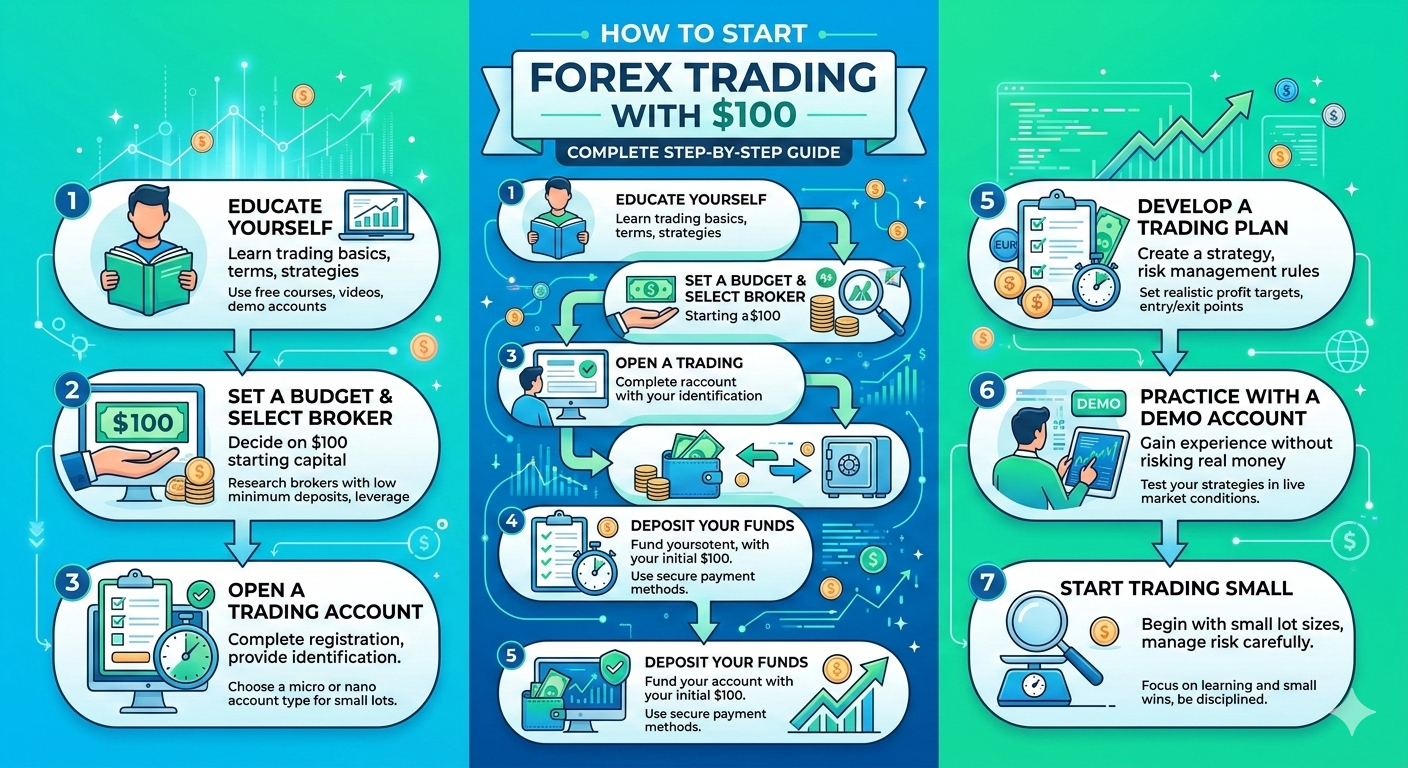
  • “How to Start Forex Trading with $100 – Complete Step-by-Step Guide

    “How to Start Forex Trading with $100 – Complete Step-by-Step Guide

    Forex trading is one of the most accessible financial markets in the world. With a small starting capital like $100, anyone with internet access can participate in global currency markets. Thanks to modern online brokers and trading platforms, beginners no longer need thousands of dollars to begin.

    This complete step-by-step guide will show you how to start forex trading with $100, choose the right broker, manage risk effectively, and build a strategy designed for long-term success.


    What Is Forex Trading?

    Forex (foreign exchange) trading involves buying and selling currency pairs to profit from price fluctuations. The forex market is the largest financial market globally, with over $7 trillion traded daily.

    Currencies are traded in pairs, such as:

    • EUR/USD
    • GBP/USD
    • USD/JPY

    For example, if you believe the euro will strengthen against the US dollar, you buy EUR/USD. If the price rises, you profit.

    Unlike stock markets such as the New York Stock Exchange, the forex market operates 24 hours a day, five days a week, making it highly flexible for traders worldwide.


    Can You Really Start Forex Trading with $100?

    Yes, you can start forex trading with $100. Many regulated brokers allow minimum deposits between $10 and $100. However, trading with a small account requires:

    • Strict risk management
    • Smart position sizing
    • Low leverage usage
    • Strong discipline

    While $100 will not make you rich overnight, it is enough to learn, practice, and potentially grow your account gradually.


    Step 1: Learn the Basics of Forex Trading

    Before depositing money, understand key forex concepts:

    1. Currency Pairs

    Forex trades always involve two currencies. The first currency is the base currency; the second is the quote currency.

    2. Pips

    A pip is the smallest price movement in a currency pair.

    3. Leverage

    Leverage allows you to control larger positions with a small deposit. For example, 1:100 leverage means you can control $10,000 with $100. While leverage increases profit potential, it also increases risk.

    4. Spread

    The spread is the difference between the buy and sell price. Lower spreads mean lower trading costs.

    Understanding these terms is essential before placing your first trade.


    Step 2: Choose a Reliable Forex Broker

    Selecting the right broker is crucial, especially when trading with a small account.

    Look for:

    • Regulation by trusted authorities
    • Low minimum deposit ($10–$100)
    • Tight spreads
    • Fast execution
    • Negative balance protection
    • Demo account availability

    Regulation helps protect traders from fraud. In the United States, forex brokers are overseen by the Commodity Futures Trading Commission and the National Futures Association.

    If you are outside the US, check your country’s financial regulatory authority.


    Step 3: Open and Verify Your Trading Account

    After choosing a broker:

    1. Register on their website
    2. Submit identity verification (KYC documents)
    3. Deposit your initial $100
    4. Download the trading platform (usually MetaTrader or a proprietary app)

    Many brokers offer demo accounts. Practice with virtual money before trading real funds.


    Step 4: Choose the Right Trading Strategy

    With only $100, you must use low-risk strategies. Avoid aggressive trading.

    Recommended Strategies for Small Accounts

    1. Trend Trading

    Trade in the direction of the overall market trend. Use moving averages to identify trends.

    2. Support and Resistance Strategy

    Buy near support levels and sell near resistance levels.

    3. Breakout Trading

    Enter trades when price breaks key levels with strong momentum.

    Keep your strategy simple. Complex strategies often lead to confusion and losses for beginners.


    Step 5: Use Proper Risk Management

    Risk management is the most important factor when trading with $100.

    Follow the 1–2% Rule

    Risk only 1–2% of your account per trade.

    With a $100 account:

    • 1% risk = $1 per trade
    • 2% risk = $2 per trade

    This prevents large losses and helps your account survive during losing streaks.

    Always Use a Stop-Loss

    A stop-loss automatically closes your trade if the market moves against you.

    Avoid Overleveraging

    Even though brokers offer high leverage, do not use maximum leverage. It can wipe out your account quickly.


    Step 6: Start with Major Currency Pairs

    Major pairs are best for beginners because they:

    • Have lower spreads
    • Offer higher liquidity
    • Show smoother price movements

    Examples include:

    • EUR/USD
    • GBP/USD
    • USD/JPY

    Exotic pairs often have higher spreads and more volatility, making them riskier for small accounts.


    Step 7: Develop a Trading Plan

    A trading plan helps you stay disciplined.

    Your plan should include:

    • Entry rules
    • Exit rules
    • Risk per trade
    • Trading hours
    • Daily loss limit

    For example:

    • Risk 1% per trade
    • Stop trading after losing 3 trades in one day
    • Trade only during London or New York sessions

    Discipline separates profitable traders from emotional traders.


    Step 8: Track and Analyze Your Trades

    Keep a trading journal.

    Record:

    • Entry price
    • Exit price
    • Reason for trade
    • Outcome
    • Lesson learned

    Reviewing your journal helps improve your strategy and eliminate repeated mistakes.


    Common Mistakes to Avoid When Trading with $100

    1. Overtrading

    Taking too many trades increases costs and risk.

    2. Using High Leverage

    Many beginners lose money quickly due to excessive leverage.

    3. Chasing Losses

    Trying to recover losses by increasing trade size often leads to bigger losses.

    4. Ignoring Risk Management

    Even a good strategy fails without proper risk control.


    How to Grow a $100 Forex Account

    Growing a small account requires patience.

    Focus on Consistency

    Aim for small steady gains instead of large risky profits.

    Compound Profits

    As your account grows, increase position size gradually while keeping risk percentage constant.

    Continue Learning

    Study price action, technical indicators, and market fundamentals.

    Some traders also monitor financial news and economic data releases that impact currency markets.


    Is Forex Trading Profitable with $100?

    Yes, but expectations must be realistic.

    A $100 account will not generate full-time income immediately. However, it can:

    • Help you gain real trading experience
    • Teach discipline and risk management
    • Serve as a foundation for future capital growth

    Many professional traders started with small accounts before scaling up.


    Final Thoughts: Start Smart, Trade Smart

    Starting forex trading with $100 is possible, but success depends on discipline, education, and risk management.

    To summarize:

    1. Learn forex basics
    2. Choose a regulated broker
    3. Practice on a demo account
    4. Use simple strategies
    5. Risk only 1–2% per trade
    6. Keep emotions under control
    7. Focus on long-term growth

    Forex trading offers flexibility and opportunity, but it also carries significant risk. Approach it like a business, not a gamble.

    If you stay patient, manage risk properly, and continuously improve your skills, your $100 trading account can become the first step toward financial growth.